The waterfall of
worldview formation.
Different subjects. Deeper connections.
It is easy to encounter a publication as a collection of opinions. An essay about Bitcoin here. A Bible study there. An argument about energy, politics, or artificial intelligence somewhere else.
The waterfall explains how I see those subjects fitting together. Our views downstream draw on answers to questions upstream: how we know what is true, what exists, what is good, what a human being is, and what life is for.
When people disagree about a policy, they may also disagree about human nature, moral responsibility, or what qualifies as knowledge. Finding that deeper disagreement can make the conversation far more useful.
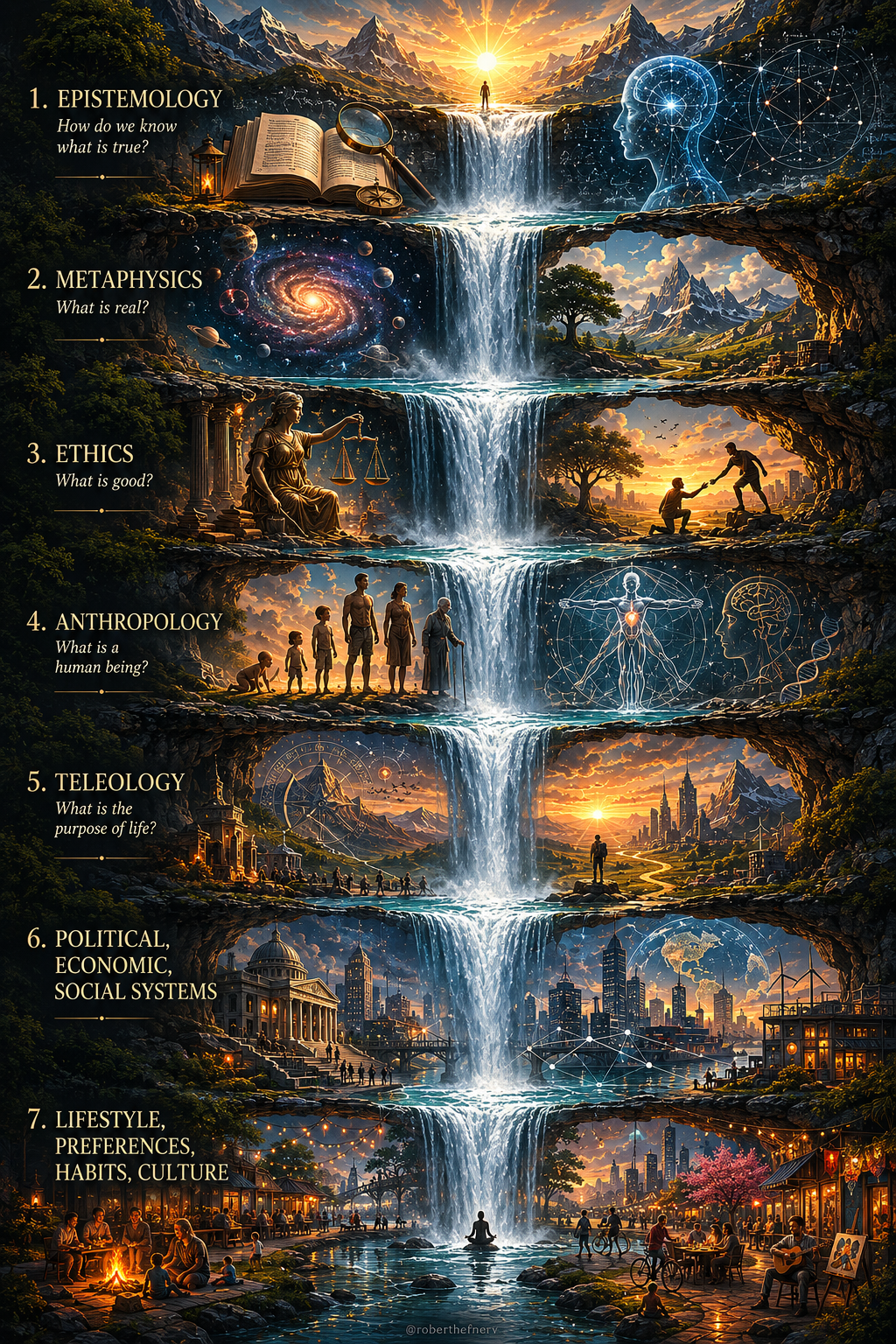
Epistemology
How do we know what is true?
Before debating an answer, examine the method used to reach it. What counts as evidence? What could show an explanation to be wrong? This is where criticism, intellectual humility, and Popper’s contribution become practical. A claim deserves examination even when it is popular—and even when I agree with it.
Metaphysics
What is real?
Our methods of knowing bear on what we believe about reality itself: whether truth exists independently of us, whether the world is intelligible, and whether creation has a Creator. My Christian convictions belong here, while Scripture also informs the questions that follow.
Ethics
What is good?
A description of what exists does not, by itself, settle what we ought to do. We also need moral premises. What makes an action right? What do we owe another person? What limits should govern the pursuit of an otherwise desirable outcome? These questions matter whenever progress, profit, power, or convenience is offered as its own justification.
Anthropology
What is a human being?
Here, anthropology means our account of human nature. Are people capable of reason, choice, growth, and responsibility? How should we understand dignity, weakness, and the capacity for evil? Our answers shape how we teach, lead, parent, build institutions, and think about the relationship between human beings and machines.
Teleology
What is the purpose of life?
What are we living toward? Purpose gives direction to action. It affects which goals deserve our effort, what we are willing to sacrifice, and what we mean by a life well lived. The question follows us into work, family, faith, and the everyday decisions through which a life takes shape.
Political, economic, social systems
How should we organize life together?
Our views of knowledge, reality, goodness, human nature, and purpose have consequences for institutions. Who should hold power? How should error be corrected? What can prices communicate? What belongs to the individual, and what may government legitimately require? This is where philosophy meets law, markets, money, geopolitics, and energy policy.
Lifestyle, preferences, habits, culture
How do those convictions become a way of life?
The waterfall reaches the choices we make repeatedly: what we read, how we spend, what we build, how we treat people, and which habits we cultivate. A worldview becomes visible in a life. Experience here can also expose inconsistencies and send us back upstream to examine what we have assumed.
How to read the waterfall
The order is a way to examine dependencies. It does not mean that every belief follows automatically from the one above it. Moral judgments require moral premises; a theory of knowledge alone cannot supply them. We can also discover an error downstream and return upstream to correct it.
Consider artificial intelligence. We first need to ask what is known and how a forecast could be tested. We then encounter questions about intelligence and human nature, moral limits, worthwhile purposes, and the institutions through which the technology should develop. Those questions eventually reach the choices of businesses, governments, families, and individual users.
The same movement connects energy with human flourishing, Bitcoin with monetary institutions, and Bible studies with the way we actually live. The sections organize the subjects. The waterfall makes the underlying questions visible.
Think clearly. Live wisely.Explore the writing by subject →